
Chiller preventive maintenance is the scheduled inspection, cleaning, testing, and monitoring of commercial chiller equipment to identify developing problems, maintain cooling performance, and reduce unexpected breakdowns. For facilities in New Orleans and similar hot, humid climates, a structured commercial chiller maintenance service program is not optional; it is the difference between reliable year-round cooling and emergency calls during peak demand.
This guide covers what facility managers, hotel engineers, plant operators, and building owners need to know about chiller maintenance: what it includes, how often each task should happen, what warning signs to watch for, and how to evaluate a service partner.
Key Takeaways
- Commercial chiller maintenance service covers inspection, cleaning, testing, adjustments, and performance verification for large building chiller systems. Skipping it accelerates wear, increases energy waste, and leads to premature chiller replacement.
- Both air cooled chillers and water cooled chillers need scheduled care, including daily logs of pressure and temperature readings, monthly inspections, and annual professional service to keep chilled water temperatures stable and energy use under control.
- A structured preventive maintenance program reduces emergency breakdowns, protects mission-critical operations in hospitals, hotels, data centers, and industrial facilities, and can extend chiller system life past 25 years.
- Professional commercial chiller services go beyond basic coil cleaning. They include diagnostics, chiller repair, optimization, controls calibration, vibration analysis, oil analysis, and staff training.
- For complex central plant and process-cooled chillers, working with a licensed, experienced contractor with verified technician certifications is the safest approach.
What Is Commercial Chiller Maintenance Service?
Commercial chiller maintenance service is the planned care of large-capacity refrigeration equipment used to produce chilled water for building comfort cooling or industrial process cooling. It includes inspection of mechanical, electrical, and refrigerant components; cleaning of heat transfer surfaces; adjustment of controls and setpoints; and verification that the chiller system operates within design parameters.
“Chiller service” covers both preventive tasks (routine care performed on a schedule) and corrective tasks (troubleshooting and chiller repair after a fault or performance deviation). A single service agreement typically addresses both.
The types of commercial chillers covered include:
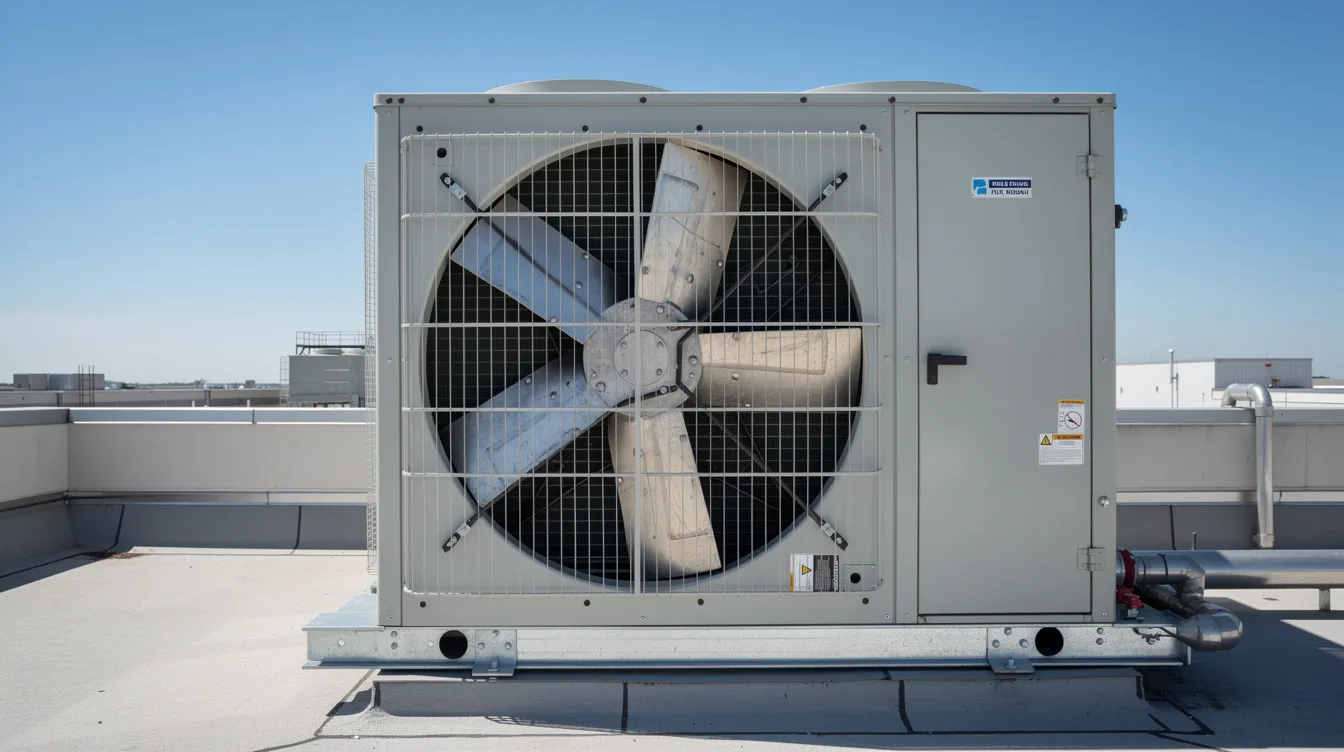
- Air cooled chillers on rooftops or at grade, rejecting heat through condenser coils and fans
- Water cooled chillers paired with cooling towers and condenser water loops
- Process-cooled chillers serving industrial loads such as manufacturing, food production, or data center cooling
Maintenance applies to centrifugal, screw, scroll, and absorption machines. Centrifugal chillers are commonly used in large industrial settings and central plants. Absorption chillers use heat instead of mechanical compression, requiring different chemical and operational checks. Each compressor type has distinct procedures, intervals, and failure modes.
Why Commercial Chiller Maintenance Matters for Large Facilities
Chillers are among the most critical and energy-intensive systems in a commercial building. A single centrifugal chiller in a mid-size office tower or hospital can draw hundreds of kilowatts. When that equipment degrades, the financial and operational consequences compound fast.
Neglecting maintenance increases energy consumption; an inefficient chiller can raise HVAC energy use by 10 to 30 percent above design, depending on the degree of fouling, refrigerant loss, or control drift. Poorly maintained chillers lead to higher operational costs over time, and the degradation often goes unnoticed until a failure forces an emergency response.
Key risks of deferred chiller maintenance:
- Unstable chilled water temperatures that affect tenant comfort, patient safety, or product quality
- Unexpected shutdowns during peak cooling demand; chiller failures rarely happen during standard business hours, making after-hours emergency response a recurring cost
- Production disruptions: chiller downtime can disrupt other equipment operations in manufacturing, pharmaceutical, and food processing facilities
- Accelerated wear on compressors, motors, bearings, and heat exchangers, shortening equipment life by years
- Regulatory exposure where temperature control is tied to food safety codes, pharmaceutical guidelines, or contractual SLAs
Proactive maintenance extends the useful life of expensive chiller equipment. The DOE Better Buildings program reports that following industry best operations and maintenance practices saves 5 to 20 percent on energy bills annually for commercial HVAC equipment.
How Commercial Chiller Systems Work (High-Level Overview)
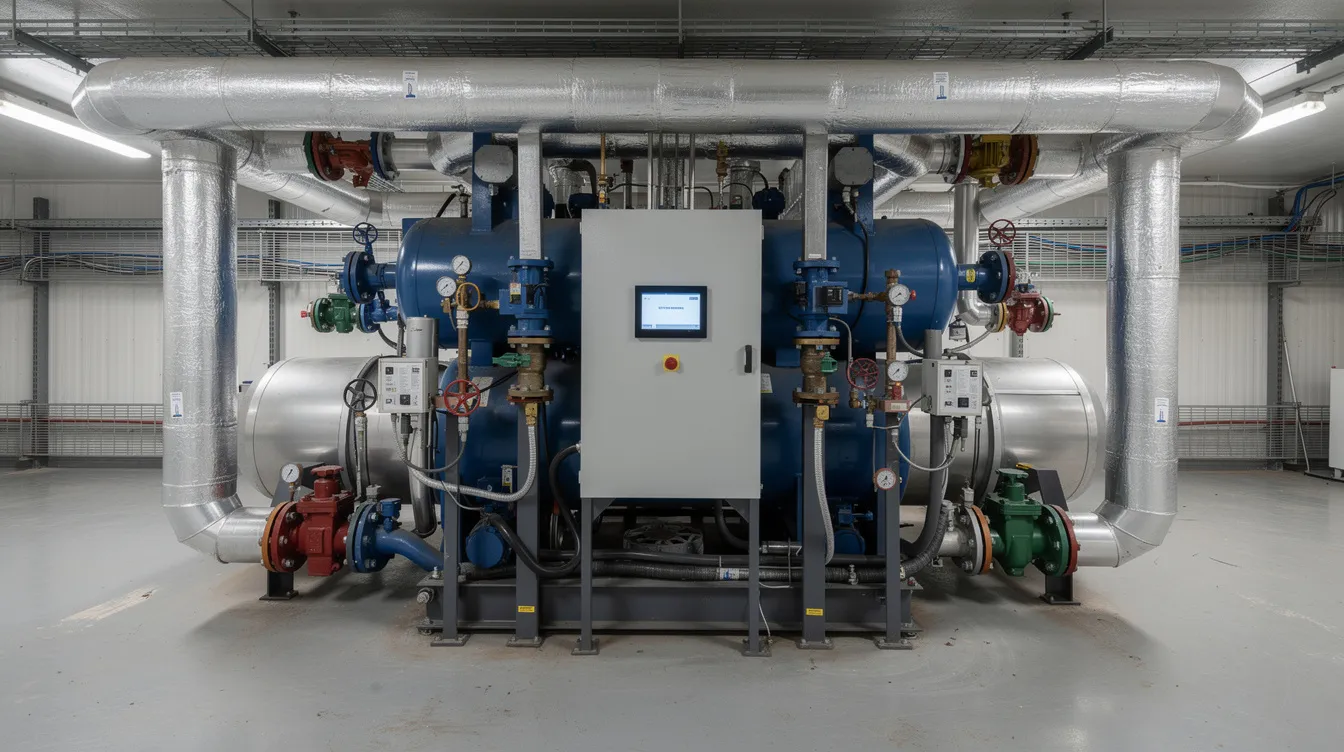
A commercial chiller removes unwanted heat from a circulating fluid (usually water or a glycol mix) using a vapor compression cycle. The four main components in this cycle are the evaporator, compressor, condenser, and expansion device. Refrigerant absorbs heat from the chilled water in the evaporator, the compressor unit raises the refrigerant’s pressure and temperature, the condenser rejects that heat to an external medium (air or water), and the expansion device drops pressure to restart the cycle.
Two distinct water loops serve most chiller plants:
- Chilled water loop: carries cooled water from the evaporator to air handling units, fan coils, or process equipment throughout the building, then returns warmer water to the evaporator
- Condenser water loop (water cooled chillers only): carries heated water from the condenser to cooling towers, where the cooling effect of evaporation rejects heat to the atmosphere
Chillers need between 2.5 and 3 gallons per minute per ton of cooling capacity for proper flow rates and efficiency. Evaporative condensed chillers are effective in hot, dry climates where wet-bulb depression is large, though they are less common in humid markets like New Orleans.
Maintenance focuses on heat transfer surfaces (tubes, coils, fins), moving parts (compressor, fans, pumps), the refrigerant circuit, controls, and water treatment. Understanding where these components sit in the system helps facility staff communicate problems to technicians and understand why each maintenance task matters.
Core Elements of a Commercial Chiller Maintenance Program
An effective chiller maintenance program is built around two axes: frequency (daily, monthly, seasonal, annual) and task type (inspection, cleaning, testing, adjustment, repair). Comprehensive preventive maintenance programs include critical technical services that go well beyond changing filters.
Key components of a complete program:
- Mechanical inspections: check compressor condition, bearing wear, belt tension, fan blade integrity, and pump operation
- Refrigerant management: verify charge levels, test for refrigerant leaks, confirm subcooling and superheat readings
- Electrical checks: inspect motors, tighten electrical connections, measure voltage and amperage, test insulation resistance
- Water treatment: coordinate condenser water and chilled water chemistry with a treatment specialist
- Control system verification: confirm setpoints, sensor calibration, safety interlocks, and alarm functionality
- Documentation and daily logs: record operating data for trend analysis and compliance
Manufacturer recommendations, equipment age, hours of operation, and the local environment all influence how deep and frequent each task should be. Regular maintenance reduces emergency repair needs, prevents expensive emergency breakdowns, and decreases potential chiller maintenance costs. Many facility managers pair internal routines (basic checks, daily logs) with a professional commercial chiller service contract for specialized tasks like tube cleaning, vibration analysis, and refrigerant circuit work.
Daily and Routine Checks: The Role of Chiller Operating Logs
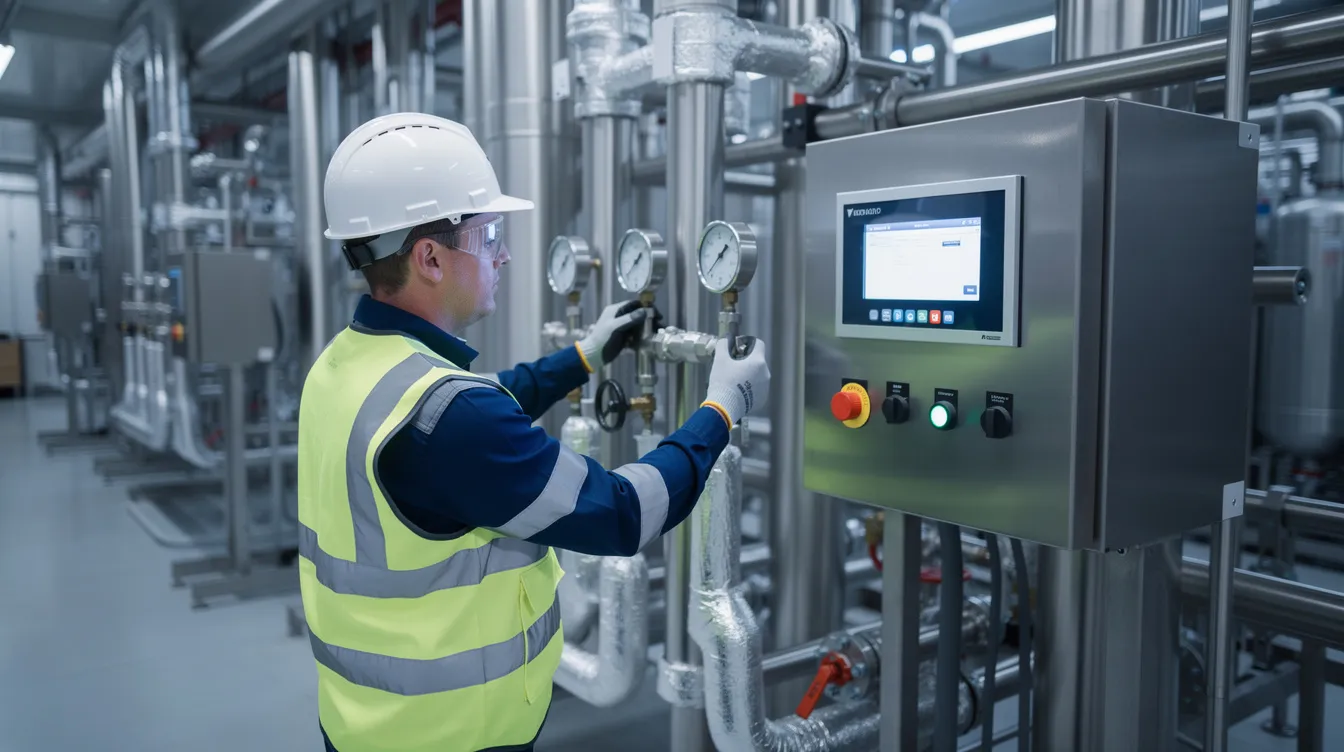
Daily logs are the foundation of any preventive maintenance program. They establish baselines, reveal gradual drift, and provide the data a chiller technician needs to diagnose problems before they cause a shutdown. Routine checks maintain steady cooling capacity and avoid unexpected temperature swings.
Maintain daily logs of pressure and temperature for chillers. A sample daily log should capture:
- Entering and leaving chilled water temperatures
- Condenser water temperatures (supply and return, for water cooled units)
- Suction and discharge pressures at the compressor
- Compressor amperage
- Oil pressure and fluid levels (where applicable)
- Alarm history and status codes
- Run hours, number of starts, and load percentage
Visual and auditory checks matter too. Walk the mechanical room daily and note unusual noise, vibration, leaks, corrosion, or abnormal odors around the chiller, pumps, or piping. These observations, logged consistently, become the earliest indicators of bearing wear, refrigerant loss, or electrical faults.
Tracking run hours and start counts supports predictive planning. When a chiller approaches its expected end of life or an unusual number of starts accumulates in a short period, the data supports a proactive decision about chiller replacement rather than a reactive scramble after failure.
Monthly, Seasonal, and Annual Chiller Maintenance Tasks
More in-depth tasks are performed less frequently but have a large impact on chiller efficiency and reliability.
Monthly tasks:
- Check strainers and clean as needed; plugged strainers reduce flow rates and starve the evaporator
- Verify pump operation, motor amperage, and differential pressure across the evaporator and condenser
- Review control setpoints and compare to design intent
- Sample condenser water and chilled water for chemistry parameters
- Confirm temperature differentials match expected values; a low delta-T on the chilled water side often signals flow problems or fouling
Seasonal tasks (start-up and shutdown):
- Full system inspection before the cooling season begins
- Verify freeze protection (glycol concentration, heat trace, low-ambient lockouts)
- Confirm cooling tower operation: fan rotation, fill condition, basin cleanliness, drift eliminators
- Adjust setpoints for summer peak load versus shoulder-season conditions to reduce compressor lift
Annual tasks:
- Condenser and evaporator tube cleaning (mechanical brushing or chemical treatment) to remove scale and fouling
- Eddy-current testing for tube wall integrity on water cooled chillers
- Oil analysis should be done every year for chiller compressors; chiller oil analyzed annually reveals moisture contamination, acid formation, and metal particles that signal internal wear
- Megger testing of motor insulation to catch degradation before a winding failure
- Safety and control calibration: verify relief valves, flow switches, high/low pressure cutouts
- Full chiller performance test under load to measure actual kW/ton against rated performance
Actual task lists and intervals must follow manufacturer requirements from brands like Trane, Carrier, York, or McQuay, as well as local codes. A one-size-fits-all checklist does not replace the equipment-specific industrial chiller maintenance checklist provided by the OEM.
Air-Cooled vs. Water-Cooled Commercial Chillers: Maintenance Differences
Air cooled and water cooled commercial chillers share the same basic function, but their maintenance needs differ because of how each type rejects heat.
Air cooled chiller maintenance focuses on:
- Condenser coils: cleaning debris, pollen, dirt, and salt deposits from fin surfaces; in coastal areas like New Orleans, coil corrosion from salt air accelerates if coatings are not maintained
- Fans and motors: inspect motors, check blade condition, verify proper rotation and airflow clearance around the unit
- Ambient controls: confirm low-ambient lockouts and head pressure controls function correctly
- Refrigerant circuit: leak detection is critical because air cooled chillers are exposed to weather and thermal cycling, which stress joints and fittings
Air-cooled chillers use fans for heat transfer, and full-load efficiency typically falls in the 0.8 to 1.2 kW/ton range.
Water cooled chiller maintenance focuses on:
- Condenser tubes: inspection and cleaning to remove scale, biological growth, and sediment
- Condenser water treatment: control of pH, hardness, dissolved solids, and microbial activity to protect tubes and maintain heat transfer
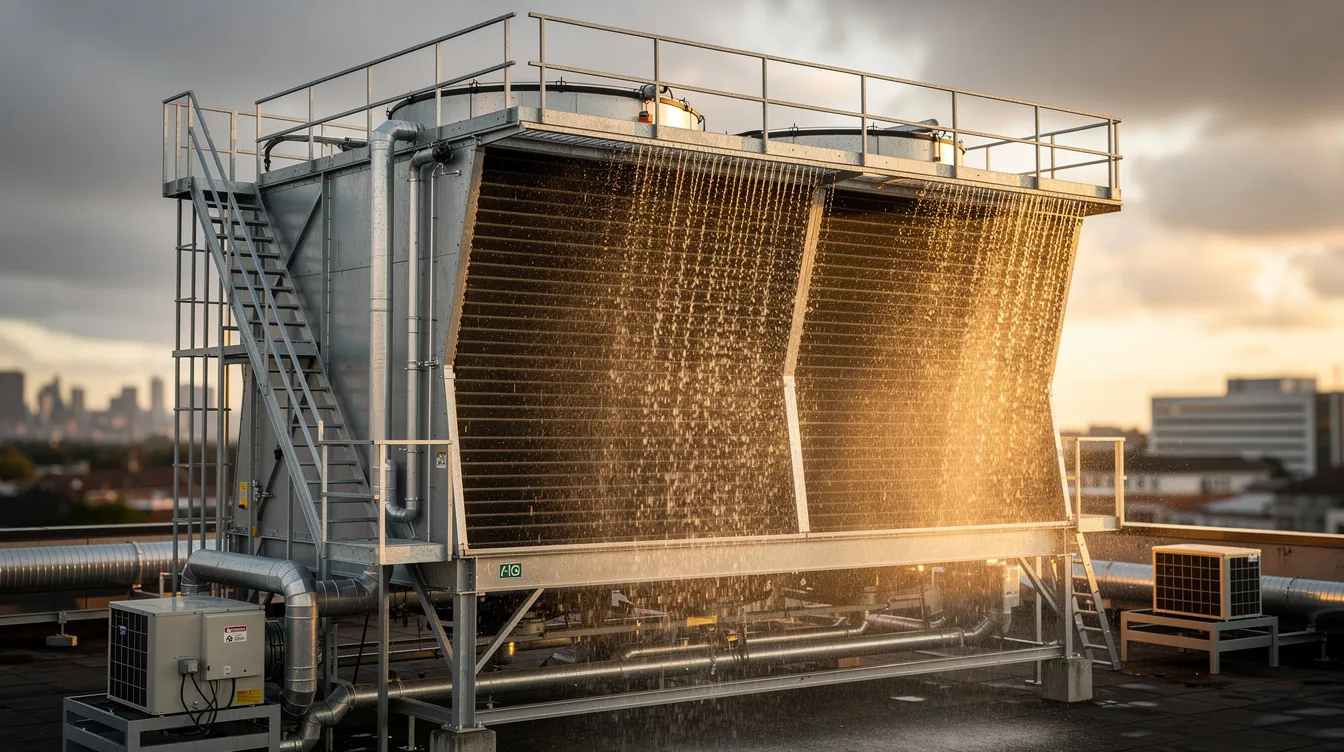
- Cooling tower upkeep: fill media, basin, drift eliminators, fan motors, and water inlets
- Pumps and strainers in the condenser water loop: verify flow, pressure drop, and pump curves
Water-cooled chillers are more efficient than air-cooled chillers, commonly achieving 0.5 to 0.7 kW/ton under good conditions, because the condensing temperature tracks wet-bulb rather than dry-bulb temperature. That efficiency advantage comes with more maintenance overhead: water treatment, tower upkeep, and a larger number of rotating components.
Neither system is universally “better.” Air cooled chiller systems have lower installation complexity and no water treatment burden, while water cooled chillers deliver higher efficiency for large facilities willing to invest in the additional infrastructure and ongoing care.
Common Signs Your Commercial Chiller Needs Service or Repair
Early detection of abnormalities prevents major failures and emergency outages. Regular inspections identify refrigerant leaks and electrical hazards before they escalate. Unexpected chiller failures can lead to costly downtime, so knowing what to watch for matters.
Performance symptoms:
- Chiller cannot hold the chilled water temperature setpoint
- Cooling capacity drops without a corresponding change in load
- Energy consumption rises at the same load, visible in daily logs or utility bills
- Frequent nuisance alarms or repeated short cycling (rapid on/off)
- Unexplained trips or safety lockouts
Mechanical symptoms:
- New or worsening vibration from the compressor, motor, or pump bearings
- Unusual compressor noise, such as metallic grinding, surging, or liquid slugging sounds
- Visible oil or refrigerant leaks at fittings, sight glasses, or valve stems
- Hot spots on electrical components detected during thermographic scans
Hydronic symptoms:
- Low chilled water flow or condenser water flow below design
- Air entrained in the chilled water system, causing erratic pump behavior
- Plugged strainers limiting flow rates
- Condenser water temperature drifting above design approach
Facility personnel should call a chiller technician whenever operating data moves outside the equipment’s normal range for more than a short, explainable period. Waiting until a hard failure occurs almost always costs more than an early diagnostic visit.
Chiller Repair, Upgrades, and Replacement Decisions
Even with consistent chiller machine maintenance, components wear out. Compressors accumulate hours, tubes thin, motor insulation degrades, and controls become obsolete. Knowing when to repair and when to invest in a new chiller is a capital planning decision that should be driven by data, not panic.
Typical repair scenarios:
- Compressor rebuilds or replacement
- Re tube of condenser or evaporator bundles
- Motor rewind or replacement
- Controls retrofit to modern DDC or building automation
- Refrigerant circuit leak repair and recharge
Upgrade opportunities:
- Adding variable speed drives to pumps, fans, or compressors to improve part-load efficiency
- Modernizing controls for chilled water reset, condenser water reset, or optimal start/stop sequences
- Improving compressed air and pneumatic actuator systems tied to chiller plant valves
Key factors in a repair vs. replace decision:
- Age of the chiller relative to expected life. ASHRAE data shows centrifugal chillers can last over 25 years with proper maintenance; scroll chillers often reach 10 to 15 years.
- Efficiency degradation: if measured kW/ton exceeds rated performance by more than 15 percent, the unit is costing real money every hour it runs
- Whether the refrigerant is subject to phase-out under EPA AIM Act regulations
- Frequency and cost of recent repairs
- Availability of OEM parts
A reputable commercial chiller service provider should offer life-cycle cost comparisons and multi-year budgets. The University of Cincinnati chiller replacement project is instructive: new magnetic bearing centrifugal chillers achieved 0.36 kW/ton on average versus the previous 0.68 kW/ton, saving over $340,000 in year two.
Water Quality, Condenser Water, and Chilled Water Loop Care
Poor water quality is one of the fastest ways to damage cooled chillers, piping, and heat exchangers. Scale deposits as thin as 1/32 of an inch on condenser tubes measurably reduce heat transfer, raise condensing pressure, and force the compressor to work harder.
Condenser water loop treatment priorities:
- Scale control: manage hardness and alkalinity to prevent calcium carbonate buildup
- Corrosion inhibition: protect copper tubes, steel piping, and tower basin metals
- Biological control: prevent algae, biofilm, and Legionella growth in towers and basins; this is a public health requirement, not just a maintenance preference
- Sludge and sediment removal: basin sweeps, side-stream filtration, and blowdown management to remove contaminants
Chilled water loop best practices:
- Inspect chilled water loops at least yearly for contaminants, corrosion products, and air entrainment
- Maintain proper glycol concentration where freeze protection is needed
- Use corrosion inhibitors appropriate to the metals in the system
- Sample and test water periodically with a qualified water treatment specialist
Fouling increases approach temperatures, degrades chiller efficiency, and can push condensing pressures high enough to trigger safety lockouts. One documented case showed that cleaning condenser tubing recovered about 6 percent efficiency, producing $111,000 in annual savings with a 1.2-year payback.
Energy Efficiency and Optimization Through Proactive Chiller Maintenance
Focused preventive maintenance can reduce energy use without requiring major capital investment. An inefficient chiller can increase HVAC energy use by double-digit percentages, while routine maintenance lowers energy costs by maintaining efficient operation across every component in the chiller plant.
Practical optimization strategies tied to maintenance:
- Clean heat transfer surfaces: every degree of approach temperature improvement at the condenser or evaporator reduces compressor lift and energy consumption
- Verify condenser water temperatures: resetting condenser water setpoint downward when outdoor wet-bulb conditions allow reduces compressor work; even 1°F matters at scale
- Calibrate sensors: temperature, pressure, and flow sensors that drift cause controls to make poor decisions, wasting energy without any visible alarm
- Maintain proper refrigerant charge: undercharge reduces cooling capacity; overcharge raises discharge pressure; both waste energy
- Confirm flow rates: chillers need 2.5 to 3 GPM per ton for efficiency; deviations reduce heat transfer and can damage evaporator tubes
Tuning control strategies like chilled water reset, condenser water reset, and optimal start/stop depends on accurate data from well-maintained sensors. Detailed daily logs and trending reveal inefficiencies such as excessive lift, low delta-T syndrome, or pumps and towers running harder than necessary.
A mid-Atlantic campus case study demonstrated the payoff: after implementing runtime-based chiller sequencing and targeted maintenance, the facility reduced energy use by 19 percent and unnecessary chiller runtime by 31 percent. Regular maintenance decreases chiller maintenance costs while delivering measurable energy savings year over year.
Choosing a Commercial Chiller Service Partner
Specialized experience with commercial chillers matters. General HVAC knowledge does not prepare a technician for eddy-current testing a 500-ton centrifugal chiller or diagnosing surge on a variable-speed compressor. Technicians should be verified for certifications and training specific to chillers, including manufacturer-authorized coursework for the equipment in your plant.
Evaluation criteria:
- Valid mechanical contractor licensing (state and local)
- Technician certifications: EPA Section 608, manufacturer training for your chiller models (centrifugal, screw, scroll, air cooled, water cooled)
- Demonstrated experience with your facility type (hospitals, hotels, industrial facilities, data centers)
- 24/7 emergency response capability; emergency chiller services should respond within two hours for urgent issues
- Service Level Agreements should define emergency response times, scope of coverage, and escalation procedures
Support capabilities to confirm:
- Access to OEM parts from major brands
- Tube cleaning equipment, vibration analysis tools, oil analysis partnerships
- Controls expertise and integration with building automation systems
- Detailed service reports that help with budgeting and compliance; experienced technicians deliver written findings, performance data, and prioritized recommendations after every visit
Request references from facilities similar to yours. Ask about response times, communication quality, and whether the contractor distinguishes between repair and chiller replacement recommendations with data, not just estimates. Expert technicians will present life-cycle cost comparisons rather than defaulting to the most expensive option.
Coordinating Maintenance With Facility Operations and Safety
Chiller maintenance must be planned around building schedules, production windows, and safety requirements. A hotel in New Orleans cannot lose chilled water during a July convention; a hospital cannot lose process cooling to an operating suite.
Scheduling coordination:
- Work with tenants, production teams, or clinical staff to schedule shutdowns during low-demand windows
- For facilities with multiple chillers, rotate maintenance so at least one unit remains operational; redundancy planning is part of the maintenance services scope
- Sequence seasonal start-up tasks to complete before peak cooling demand arrives
Safety requirements:
- Lockout/tagout procedures for every chiller, pump, and electrical disconnect
- Confined space protocols for mechanical rooms, pits, and cooling tower basins
- Chemical handling procedures for water treatment chemicals (biocides, scale inhibitors, acid cleaners)
- Proper refrigerant handling per EPA regulations; commercial refrigerant charges can be hundreds of pounds
Document all work performed. Update one-line diagrams and valve maps. Verify controls sequences after any maintenance that touches wiring, sensors, or actuators. Where chillers support fire protection, life safety, or critical process cooling for sensitive equipment, involve risk management and insurance carriers in the planning process.
Training Facility Staff to Support Professional Chiller Services
On-site staff are the first line of defense. Building engineers and maintenance personnel who understand basic chiller operation catch problems days or weeks before a catastrophic failure. A trained operator who notices a 3°F rise in leaving chilled water temperature and reports it can prevent overheating of critical loads and save thousands in emergency repair costs.
Training goals for facility staff:
- Understand normal temperature and pressure ranges for each chiller in the plant
- Read and interpret trend logs and alarm codes
- Recognize the difference between a nuisance alarm and a condition requiring immediate shutdown
- Know when to escalate to a qualified chiller technician versus attempting a field correction
- Perform daily log entries accurately and consistently
- Execute simple housekeeping: clean strainer screens, verify pump operation, clear debris from air cooled condenser coils
Training does not replace a professional chiller technician. It helps facility personnel identify and communicate potential problems, supporting faster diagnosis and reducing wasted service calls. This is a responsible technical boundary: staff training covers monitoring, documentation, and safety, not compressor teardowns or refrigerant circuit work.
Refresher training should occur whenever equipment is upgraded, new controls or installation work is completed, or new team members join the engineering or maintenance department. The strongest reliability outcomes come from a partnership between trained in-house personnel and an experienced commercial chiller service contractor, where each side handles what it does best.
Frequently Asked Questions About Commercial Chiller Maintenance Service
How often should a commercial chiller be serviced?
Daily monitoring by on-site staff, monthly inspections of key operating parameters, and at least annual comprehensive professional service are typical for most commercial facilities. Actual intervals depend on manufacturer guidance, equipment age, operating hours, water quality, and how critical the cooling load is to your business. Planned maintenance on this schedule can reduce downtime and operating surprises.
What is included in a professional chiller maintenance visit?
A professional visit typically includes operational checks (temperatures, pressures, flow), safety and control verification, inspection of mechanical and electrical components, basic cleaning of strainers and accessible surfaces, performance measurements (kW/ton, delta-T, approach temperatures), and a written report with prioritized repair recommendations. For annual visits, services may also include tube cleaning, oil analysis, motor insulation testing, and refrigerant circuit evaluation. This represents a complete chiller machine maintenance scope that goes well beyond what in-house staff handle daily.
Can in-house maintenance staff handle all chiller maintenance tasks?
In-house teams can manage daily logs, visual inspections, filter and strainer checks, and simple housekeeping like clearing debris from condenser coils. Specialized diagnostics, refrigerant leak detection and repair, compressor overhauls, eddy-current tube testing, and vibration analysis should be performed by qualified chiller technicians. Many industrial processes depend on continuous chilling, and attempting complex repairs without proper training risks both equipment damage and personnel safety.
How do I know when it is time to replace rather than repair a chiller?
Consider the chiller’s age relative to expected life (chillers can operate for over 25 years with good maintenance, but scroll units may reach end of life at 10 to 15 years), efficiency compared to modern equipment, the frequency and cost of recent repairs, whether the refrigerant faces regulatory phase-out, and the criticality of the cooling load. A life-cycle cost analysis from a qualified service provider, comparing repair costs, energy costs of the existing unit, and capital cost of a new chiller over 15 to 20 years, is the most reliable basis for this decision.
Does good chiller maintenance really lower energy costs?
Yes. Well-executed maintenance that keeps heat transfer surfaces clean, refrigerant charge correct, flow rates at the 2.5 to 3 GPM per ton target, and controls calibrated produces measurable reductions in kW/ton. The DOE documents 5 to 20 percent annual energy savings from best practices in commercial HVAC maintenance. Neglecting these tasks produces the opposite effect: fouled tubes, low charge, and drifting sensors force the compressor to work harder for the same cooling output, turning preventable inefficiency into ongoing energy waste and higher utility bills. Replacing a commercial HVAC equipment can be very experience.