
Boiler Leaking Water Repair New Orleans: Common Causes and Solutions
Oct 26, 2026 · New Orleans Mechanical Pros
Introduction
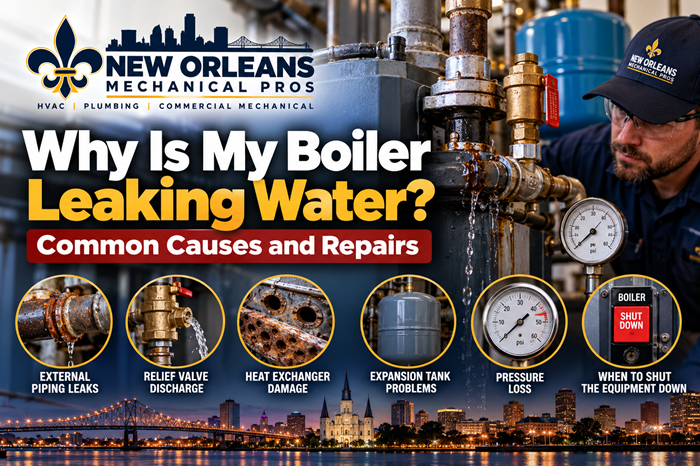
A boiler can leak water because of loose pipe connections, failed pump seals, excessive system pressure, damaged heat exchangers, or problems with the expansion tank. If you need boiler leaking water repair in New Orleans, identifying the type of leak can help diagnose the problem more efficiently-and determine whether you’re dealing with a minor fitting repair or a situation that requires immediate shutdown and professional inspection.
Boiler leaks are especially common in New Orleans commercial properties and older buildings throughout the French Quarter, Garden District, and Central Business District, where decades-old hydronic piping, high humidity, and locally treated municipal water accelerate corrosion and component wear. Hotels relying on boilers for domestic hot water, multifamily buildings with aging mechanical rooms, and homeowners with hydronic heating systems all face these challenges. Dealing with a leaking boiler requires immediate action to prevent water damage, mold growth, and potential safety hazards.
The safest response to an active boiler leak is to note where the water is coming from, check the pressure gauge from a safe distance, and call a licensed New Orleans mechanical contractor if pressure is unstable or the leak is more than a slow drip.
Here’s what you’ll learn in this article:
- How to identify the most common boiler leak sources: piping joints, relief valves, expansion tanks, pump seals, and heat exchangers
- When to shut down a boiler and when monitored operation is acceptable
- Typical repairs performed in New Orleans, including relief valve replacement, expansion tank service, and pump seal work
- What drives repair costs and why on-site diagnostics matter
- What to expect from a professional boiler leak diagnosis visit in New Orleans
Understanding Boiler Water Leaks in New Orleans Buildings
Not every drop of water near a boiler signals a dangerous problem. Before calling for emergency service, it helps to understand what qualifies as a genuine boiler water leak versus normal system behavior-and how New Orleans’ local conditions make certain failures more likely.
What Counts as a Boiler “Water Leak” vs Normal Operation?
A boiler water leak is the unintended, ongoing escape of water from piping, the boiler jacket, pump seals, valves, or the relief drain line. Boiler leaks can indicate excessive pressure, overheating, or a faulty expansion tank, and they always warrant investigation.
Normal events that are not leaks include brief relief valve discharge during scheduled testing by a technician, small amounts of water expelled during system purging at the start of the heating season, and minor condensation forming on cold piping surfaces in a humid New Orleans boiler room. Auto-bleeders expelling trapped air may also release a small amount of fluid during normal operation.
To observe whether you have a genuine leak, try the paper towel test: dry the suspected area thoroughly, run the boiler through a full heating cycle, and watch for new moisture forming. You can also place a bucket under a suspect drip point and time how quickly water accumulates. Only persistent leaks or leaks tied to pressure swings need repair-and those are the focus of this article.
Types of Boilers Commonly Found in New Orleans Properties
New Orleans properties use a range of boiler types. Hot water hydronic boilers-including cast iron sectional, steel fire-tube, and modern condensing models-are common in hotels, multifamily buildings, and larger homes. Older properties, particularly in the French Quarter and Garden District, may still operate low-pressure steam boilers with condensate return systems.
Leak locations and risks differ between these types. Steam systems are prone to header leaks, failed steam traps, and condensate piping corrosion. Condensing boilers can develop drain issues and heat exchanger failures specific to their design. While this article focuses primarily on hot water system leaks, many diagnostic principles also apply to low-pressure steam installations.
How Humidity, Age, and Water Chemistry Affect Boiler Leaks in New Orleans
New Orleans’ Gulf Coast climate creates conditions that accelerate boiler component failure. High humidity can accelerate rust and corrosion on external pipes and fittings, especially in poorly ventilated mechanical rooms, basements, and parking garages. Flood events-a recurring reality in the region-can submerge boiler room equipment, damaging insulation, controls, and piping from the outside in.
The Sewerage & Water Board of New Orleans treats water drawn from the Mississippi River, adjusting pH with lime to reduce corrosion in distribution piping. However, seasonal saltwater wedge intrusion can raise chloride levels in the water supply, increasing the corrosion potential in boiler materials-particularly steel, cast iron, and copper components. Combined with mineral content that promotes scaling, these local water chemistry factors put added stress on heat exchangers, valve seats, and piping joints. Regular flushing of boiler systems can prevent sediment buildup leading to corrosion, but many smaller New Orleans properties lack formal water treatment programs.
Most visible leaks start at external piping and fittings-the topic of the next section.
What Causes External Boiler Piping Leaks? New Orleans Mechanical Pros Explains
External piping leaks are often the first sign building staff notice: puddles on the floor, wet insulation around joints, or rust stains trailing down supply lines. These leaks occur in the piping, fittings, and valves surrounding the boiler rather than inside the pressure vessel itself.
Leaking Boiler Pipe Connections and Threaded Fittings
The most common leak points on external boiler piping include threaded unions, tees, elbows, isolation valves, packing glands, and flanged connections near the boiler headers. External fittings can become loose due to heating and cooling cycles-thermal expansion and contraction gradually work threaded joints apart over years of service. Vibration from circulator pumps compounds this effect, especially when pipe supports are inadequate or mounting hardware has corroded.
Visible signs include green or white mineral buildup around copper or brass fittings, rust trails on steel connections, and damp or deteriorated insulation. These slow leaks often start as barely noticeable seepage and worsen over time.
The important point for building owners: many of these piping leaks can be repaired without replacing the entire boiler. A corroded union or weeping valve is a localized problem that a qualified technician can address by tightening, repacking, or replacing the affected fitting.
Corrosion and Deteriorating Boiler Supply and Return Lines
In older New Orleans buildings, black steel and galvanized piping in damp boiler rooms and parking garages suffers both surface and deep corrosion. Rust and corrosion can cause pinhole leaks in boiler tanks or pipes-sometimes developing along seams or at points where insulation traps moisture against the pipe surface. What appears to be a “sweating” pipe may actually be a pinhole leak disguised by condensation.
Ignoring corroded piping carries real risks: sudden rupture can cause water damage to hotel rooms above, disrupt domestic hot water supply to occupied spaces, and create electrical hazards when water reaches nearby controls or panels. In many cases, entire sections of corroded piping must be replaced rather than patched, particularly when corrosion is widespread.
How New Orleans Mechanical Pros Diagnoses External Boiler Water Leaks
The diagnostic approach starts with visual inspection under operating conditions. Technicians dry all suspect areas, bring the boiler up to normal operating pressure and temperature, and watch for new beads of water forming at joints, valves, and fittings. System pressure and temperature readings from the pressure gauge are compared to the boiler’s nameplate data to identify abnormal conditions.
When multiple potential leak points exist, technicians isolate sections of piping using existing valves to determine whether the leak is localized to one joint or indicates system-wide corrosion. This methodical approach prevents unnecessary replacement of sound piping while ensuring the actual leak source is identified.
Can a boiler pipe leak be repaired without replacing the boiler? In most cases, yes. External piping leaks at fittings, valves, and connections are repairable without disturbing the boiler itself. The decision depends on whether the leak is isolated or part of broader piping deterioration-something that requires case-by-case evaluation on site.
Why Is My Boiler Pressure Relief Valve Leaking? New Orleans Mechanical Pros Explains
The pressure relief valve is one of the most important safety devices on any boiler. It’s also one of the most common sources of visible water leakage that New Orleans building owners notice-often as a steady drip or stream from the discharge pipe routed to a drain or the floor. A dripping boiler relief valve may indicate high boiler pressure, a bad expansion tank, a faulty fill valve, or simply a worn-out valve that can no longer reseat properly.
What Causes a Boiler Pressure Relief Valve to Discharge Water?
High internal pressure may cause water to discharge from a pressure-relief valve, which is supposed to open only when pressure rises beyond its setpoint. The underlying causes include:
- Overfilling: A faulty pressure reducing valve can continuously feed water into the boiler, raising static water pressure beyond safe limits even when the system is cold
- Failed expansion tank: A waterlogged expansion tank causes pressure to rise sharply when the boiler heats, pushing system pressure above the relief valve’s setpoint
- Overheating: If controls malfunction and water temperature climbs too high, thermal expansion creates excess pressure
- Sediment or corrosion on the valve seat: Debris prevents the valve from fully closing after it opens
- Valve age: Relief valves may wear out after 10–15 years of use and begin weeping even at normal pressures
For reference, normal boiler operating pressure is around 12–15 PSI when cold, rising to approximately 20–25 PSI during heating. Relief valves open at approximately 30 PSI to release pressure and protect the boiler from dangerous overpressure. Under Louisiana Administrative Code § V-5042, every hot water boiler must have at least one ASME/National Board–certified safety relief valve set at or below the maximum allowable working pressure. Frequent discharge from the relief valve is a symptom of an underlying problem-not the problem itself.
Is a Dripping Boiler Relief Valve Dangerous?
Occasional drops during heat-up may not constitute an emergency, but continuous flow or spraying from the relief valve is a serious warning sign. It signals that system pressure is exceeding safe limits repeatedly.
Never cap or plug a relief valve or its discharge line. Under Louisiana boiler regulations, blocking a relief valve discharge is illegal-and for good reason. Boilers involve high pressure gas or oil lines and scalding water, and a plugged relief valve removes the last line of defense against catastrophic pressure vessel failure. Using DIY sealants can clog narrow heat exchangers and safety controls in boilers, creating additional hazards.
If the relief discharge pipe is hot and water is running steadily, lower the thermostat, keep personnel away from the hot discharge, and call a licensed technician immediately.
Boiler Pressure Relief Valve Testing and Replacement in New Orleans
Before condemning a relief valve, qualified technicians verify system pressure, check the expansion tank for proper precharge, and inspect the fill valve assembly. A valve that opens correctly when tested but won’t fully reseat may have sediment on its seat or minor corrosion-sometimes cleaning resolves the issue, but often replacement is the safer choice.
Safe testing involves lifting the test lever under controlled conditions, confirming the valve opens fully and reseats without dripping. The discharge pipe must slope properly to a safe drain location without any restriction. Relief valve replacement costs $150–$350 depending on valve size, accessibility, and whether the discharge piping also needs modification. New Orleans requires securing permits for significant boiler repairs or replacements, so technicians ensure code compliance throughout the process.
Why does my boiler relief valve leak only when the boiler is heating? When the boiler heats water, thermal expansion increases system pressure. If the expansion tank cannot absorb that added pressure-because its bladder has failed or its air side precharge is incorrect-pressure climbs above the relief valve setpoint and the valve opens. The relief valve is doing its job; the expansion tank is the component that needs attention.
Can a Damaged Boiler Heat Exchanger Cause Water Leaks? New Orleans Mechanical Pros Explains
The heat exchanger is the core component where combustion heat transfers to the boiler water. When it develops cracks, pitting, or corrosion, water escapes the pressure boundary-and these internal leaks are significantly more serious than external piping drips. In commercial boilers serving New Orleans hotels or multifamily buildings, a heat exchanger failure can mean days of downtime and significant expense.
Common Signs of a Cracked or Corroded Boiler Heat Exchanger
Symptoms that suggest a heat exchanger leak include:
- Unexplained water on the floor beneath the boiler jacket, particularly near the bottom half of the unit
- Repeated low-water cutoff activations despite no visible external leaks
- A makeup water meter that constantly shows flow, indicating the system cannot hold water
- Rust streaks visible inside the combustion chamber when inspection ports are opened
- Inability to maintain stable boiler pressure even after bleeding air and repairing all visible external joints
Diagnosing a heat exchanger leak often requires opening inspection ports, performing hydrostatic testing, or using dye and ultrasonic leak detection methods. This work must be performed by qualified personnel-it involves partial disassembly and working near gas and electrical systems.
Why Boiler Heat Exchangers Fail in Commercial Buildings
Heat exchangers fail through several mechanisms. Thermal stress from rapid temperature cycling-cold water entering a hot exchanger during frequent makeup-causes expansion and contraction that fatigues metal over time. Poor water chemistry leads to scale formation; calcium deposits create hot spots underneath, promoting localized corrosion that eats through the pressure boundary.
Oxygen ingress is another major factor. Every time a system is drained and refilled, dissolved oxygen enters and attacks steel and cast iron surfaces. In New Orleans, older oversized boilers that short-cycle during mild winters experience accelerated wear, and many smaller properties lack formal water treatment programs to control pH, hardness, and dissolved oxygen levels.
Once corrosion reaches the pressure boundary, both safety and Louisiana boiler code requirements come into play. Operating a boiler with a known vessel leak is prohibited-New Orleans Mechanical Pros takes boilers with suspected shell or heat exchanger leaks offline immediately.
When Should a Boiler Heat Exchanger Be Repaired or Replaced?
Many manufacturers prohibit field welding or patching of pressure-retaining heat exchanger surfaces, and code restrictions limit what repairs are permissible on pressure vessels. Professional assessments are essential for understanding whether to repair or replace a boiler.
Key considerations include:
Factor | Favors Repair | Favors Replacement |
|---|---|---|
Boiler age | Under 10 years | Over 20 years |
Leak location | Small, accessible area | Multiple points or shell |
Parts availability | Manufacturer still supplies | Discontinued model |
Energy efficiency | Acceptable for needs | Significant savings available |
Downtime impact | Can schedule repair | Repeated emergency calls |
Is it worth repairing a leaking boiler heat exchanger? Small, accessible leaks on newer equipment where manufacturer parts are available may justify repair. However, extensive corrosion, multiple leak points, or damage on boilers older than 15–20 years typically makes replacement more cost-effective-especially when factoring in energy efficiency gains from modern condensing units and reduced emergency repair costs.
How Do Boiler Expansion Tank Problems Cause Leaks? New Orleans Mechanical Pros Explains
Many “leaking relief valve” service calls in New Orleans trace back to a failed expansion tank rather than a faulty valve. The expansion tank plays a critical but often overlooked role in maintaining stable system pressure, and when it fails, the symptoms mimic other boiler problems.
What Does a Boiler Expansion Tank Do?
In a closed-loop hydronic system, water expands as the boiler heats it. A diaphragm-style expansion tank-commonly mounted on or near the boiler-contains an internal bladder that separates air on one side from system water on the other side. Expansion tanks typically hold 2–12 gallons of water, depending on system volume and building height.
The air side of the tank is precharged to match the cold fill pressure of the system (typically 12–15 PSI). As water temperature rises and fluid expands, the air pressure cushion compresses to absorb the increase, preventing dangerous pressure spikes. Without a functioning expansion tank, every heating cycle would push system pressure toward or beyond the relief valve setpoint.
Signs of a Waterlogged or Failed Boiler Expansion Tank
A failing expansion tank can lead to constant relief valve leaks. When the internal bladder ruptures, the tank fills completely with water and loses its ability to cushion pressure changes. Signs include:
- The pressure relief valve dripping or discharging during every heating cycle
- System pressure climbing toward 30 PSI when the boiler heats, then dropping sharply when it cools
- The expansion tank feeling unusually heavy or sounding “solid” rather than hollow when you tap it
Tapping the expansion tank can help diagnose waterlogging-a properly functioning tank sounds hollow on the top half (air side) and solid on the bottom half (water side). A completely solid sound throughout indicates a waterlogged tank. Expansion tanks usually last 5–10 years before failing, though harsh water chemistry and frequent pressure cycling can shorten their lifespan.
Rusted, bulging, or visibly deteriorated tanks should be replaced promptly. Waterlogged expansion tanks typically last 5–10 years before failing, so if your tank is in that age range and symptoms are present, replacement is likely overdue.
Boiler Expansion Tank Inspection and Replacement in New Orleans
Proper inspection requires isolating the tank from the system and depressurizing it. A technician checks the Schrader air valve-if water comes out instead of air, the bladder has failed and the tank must be replaced.
For multi-story New Orleans buildings, tank sizing must account for total system volume and static head pressure from building height. An undersized or improperly precharged tank will allow pressure swings even when the bladder is intact. Expansion tank replacement costs $300–$600 depending on tank size, mounting location, and system complexity.
Can a bad expansion tank cause my boiler pressure relief valve to leak? Absolutely. A waterlogged expansion tank causes pressure to rise uncontrolled when the boiler heats. The relief valve opens because it’s designed to relieve pressure above its setpoint-it’s working correctly. Replacing the failed expansion tank and verifying proper precharge typically eliminates the relief valve discharge entirely.
Why Does My Boiler Keep Losing Pressure? New Orleans Mechanical Pros Explains
Many New Orleans building engineers and hotel maintenance staff notice dropping readings on the pressure gauge long before they see obvious water. Chronic pressure loss is one of the most frustrating boiler symptoms because the cause isn’t always visible-but it always means water is leaving the system somewhere.
How Hidden Water Leaks Affect Boiler System Pressure
Even small, hidden leaks in walls, ceiling chases, or slab piping can cause daily pressure drops that require frequent refill cycles. Potential locations include aging baseboard heating loops, rooftop risers, hotel guest room fan-coil piping, and buried supply lines.
Signs of hidden leaks include the need to constantly add water to the system, a makeup water meter that’s always moving, and air in radiators or fan-coils on upper floors. Each time you refill a hydronic system, you introduce fresh oxygenated water that accelerates internal corrosion-creating a cycle where the leak worsens and causes additional damage. Shutting off the water supply can stop continuous flooding from a boiler leak while you investigate, but it doesn’t solve the underlying problem.
Why Boiler Pressure Drops After Heating Cycles
Some pressure variation between hot and cold conditions is normal. However, excessive drops as the boiler cools-or spikes that trigger relief valve discharge when it heats-indicate a problem. Common causes include:
- A failed or improperly precharged expansion tank that can’t absorb thermal expansion
- Trapped air pockets in high points of the system that compress and release unpredictably
- Relief valve discharge during heating that goes unnoticed (water draining to a floor drain)
- Overfilled boiler systems that have high static pressure even when cold, causing the relief valve to weep and gradually lose water
An undersized tank or incorrect air pressure precharge can make pressure behavior seem erratic even with no active leak in the piping.
How New Orleans Mechanical Pros Finds Boiler Pressure Loss
The systematic diagnostic approach begins with documenting pressure readings over time-cold startup pressure, operating pressure at full temperature, and pressure after the system cools back down. Technicians inspect the relief valve discharge piping for signs of water flow, check auto vents and manual bleeders for seepage, and examine all accessible piping and components.
When the source isn’t immediately visible, isolation valves are used to segment the system into zones-boiler, near piping, and remote distribution loops-to narrow down where water is escaping.
Is it normal for boiler pressure to drop every day? Small variations of 1–2 PSI between heating cycles are normal. However, if you’re regularly needing to refill the system or the pressure gauge drops noticeably overnight, something is wrong. Frequent refilling is not normal operation-it indicates a leak that requires professional diagnosis.
When Should You Shut Down a Leaking Boiler? Safety Advice From New Orleans Mechanical Pros
Not every boiler leak requires an emergency shutdown, but some absolutely do. This section helps you figure out the difference-and what steps to take in each scenario.
Warning Signs That Require Immediate Boiler Shutdown
Shut down the boiler immediately if you observe any of the following:
- Rapidly falling system pressure on the gauge
- Water spraying or steaming from any component
- Low-water cutoff tripping repeatedly
- Banging, kettling, or unusual sounds from the vessel
- Burning smells or visible damage to the boiler shell
- Water reaching electrical controls, panels, or motor housings
- Any suspected gas odor near the boiler
Evacuating to a safe location is crucial if gas is suspected during a boiler leak. Contact the gas utility or emergency services before re-entering the area. Electrical hazards also increase significantly when water from a leak contacts controls, pumps, or wiring.
What to Do When Water Is Leaking From a Commercial Boiler
Immediate response to a boiler leak is crucial to prevent mold and water damage. Follow these steps:
- Keep all staff away from hot discharge areas-boiler water and steam can cause severe burns
- Turn off the power switch to the boiler during a leak if it is safe to do so
- Notify facility management and follow your site’s lockout/tagout and emergency shutdown procedures
- Document the leak location, behavior, and approximate flow rate with photos and notes-this helps the technician diagnose faster
What not to do: don’t bypass safety controls, don’t cap or plug relief valve discharge lines, and don’t attempt to open or tighten pressurized fittings. Most boiler repair methods should be performed by a licensed HVAC professional, not building staff working under pressure.
When to Request Emergency Boiler Leak Repair in New Orleans
Request emergency service when a leak threatens:
- Loss of heat or hot water in critical spaces (hotel guest rooms, healthcare facilities, commercial kitchens)
- Electrical equipment, data rooms, or fire suppression systems
- Building structural elements or finishes in historic properties
For slow, contained drips where system pressure remains stable and the boiler is operating normally, you may be able to schedule service during normal business hours rather than paying emergency rates. But any leak that worsens, changes character, or involves unknown causes should be treated as urgent.
Can I continue running my boiler if it is leaking water? Minor seepage at a known fitting may be monitored temporarily until a technician arrives, provided pressure is stable and no safety controls are affected. Unknown or worsening leaks warrant immediate shutdown and professional inspection-the risk of water damage, equipment failure, or safety hazard is too high to ignore.
What Causes a Boiler Circulator Pump Seal to Leak? New Orleans Mechanical Pros Explains
Many “boiler leaking from the bottom” calls turn out to be circulator pump seal failures rather than boiler shell cracks. Because circulator pumps are typically mounted at or near the base of the boiler, water from a failed seal runs downward and pools on the floor beneath the unit-creating the appearance of a much more serious problem.
Signs of a Failing Boiler Pump Mechanical Seal
Water dripping from the back or underside of the circulator pump is the most direct sign of a mechanical seal failure. Other symptoms include:
- Rust stains on the pump motor housing or mounting bracket
- Small puddles forming directly under the pump that reappear after wiping
- Noisy pump operation or reduced flow to distant heating loops
- Air entering the system through the failed seal point
In tight New Orleans mechanical rooms where multiple pieces of equipment are close together, a pump seal leak can go unnoticed for weeks-especially if it drips onto other equipment or piping before reaching the floor.
How Worn Bearings, Vibration, and Improper Alignment Affect Pump Seals
Mechanical seals in circulator pumps are precision components that rely on smooth, aligned rotation. When bearings wear, the shaft develops play that causes the seal faces to separate unevenly. Pipe strain-where rigid piping pulls or pushes on the pump flanges-creates misalignment that accelerates seal wear.
Vibration from improper mounting, worn bearings, or cavitation (caused by air in the system or insufficient supply pressure) also degrades seals prematurely. In older New Orleans boiler plants where equipment has been modified over decades, original pump supports may have corroded or been removed, adding stress to connections. Proper supports and alignment checks during installation and repair help prevent cavitation and extend seal life.
When to Replace a Boiler Pump Seal Versus the Circulator Pump
For small wet-rotor circulators commonly found in residential and light commercial systems, replacing the entire pump is often more cost-effective than sourcing and installing a seal kit-particularly when the pump is older and replacement units are readily available.
For larger commercial pumps with replaceable mechanical seals, the decision depends on the pump’s age, whether seal kits are still manufactured, and how much downtime the building can tolerate. A seal kit replacement takes less time than a full pump swap and preserves existing piping connections, but if the pump body shows corrosion or the bearings are worn, a complete replacement prevents a repeat failure in the near future.
How Much Does Boiler Water Leak Repair Cost in New Orleans?
Actual boiler repair pricing requires on-site diagnosis-no responsible contractor can provide a firm figure based on a phone description alone. However, understanding what drives cost helps building owners budget appropriately and evaluate quotes.
Factors Affecting Boiler Pipe and Valve Repair Costs
Labor time is the largest variable. Accessibility matters significantly: a valve replacement in an open, well-lit mechanical room is straightforward, while the same job in a cramped basement behind decades of piping may require scaffolding, confined space procedures, or partial disassembly of surrounding equipment. Downtown New Orleans mechanical rooms in historic buildings often present exactly these challenges.
Material costs vary by specification: copper fittings, new isolation valves, unions, and insulation replacement all contribute. Draining excess water costs $150–$300 if done by a technician, and draining and refilling large hydronic systems adds time to every repair job. Pressure reducing valve replacement costs $250–$500 depending on valve size and piping configuration.
According to local service estimates for Orleans Parish, relatively minor commercial boiler repairs-small valve, fitting, or seal work-run between $97 and $880. More complex work involving circulator pumps, expansion tanks, or piping sections can range from $500 to $1,800 or more depending on equipment size and accessibility.
Boiler Pump Seal and Expansion Tank Replacement Costs
Expansion tank replacement costs $300–$600 for typical residential and light commercial installations. Thermostat adjustment costs $100–$200 if done by a technician as part of a broader diagnostic visit.
Commercial pump seal work varies widely. Small circulator replacement may be completed in a few hours, while large pumps requiring crane or rigging access introduce significant scheduling and cost complexity. Initial diagnostics-the service visit, safety checks, and inspection-typically cost $200–$400 nationally, often credited toward repair if the same provider performs the work.
Think in terms of long-term savings: preventing water damage, avoiding unplanned shutdowns in occupied buildings, and addressing the root cause rather than repeatedly patching symptoms.
Why Commercial Boiler Repairs Require On-Site Diagnostics
Building height, boiler capacity, system design, piping materials, and prior modifications all affect repair scope. A boiler in a single-story commercial building presents different challenges than one in a 12-story hotel with rooftop risers and guest room fan-coils throughout.
New Orleans Mechanical Pros does not publish flat rates for boiler repair because quotes depend heavily on what the technician finds-whether a pump seal, valve, expansion tank, or vessel is the source. Remote quotes based only on photos are not reliable for complex leaks. Repairing a leaking boiler requires diagnosing the underlying component failure before an accurate scope and cost can be determined.
Before calling, prepare basic information: boiler make and model, approximate age, symptoms observed, and whether pressure readings have been noted. This helps the technician arrive with the right tools and potential replacement parts.
How New Orleans Mechanical Pros Diagnoses Commercial Boiler Leaks
Understanding the diagnostic process demonstrates what genuine field expertise looks like-and what you should expect from any qualified contractor responding to a boiler leak call in New Orleans.
Initial Boiler Room Safety and Operating Condition Assessment
Upon arrival, technicians verify gas and electrical safety before approaching the boiler. This includes checking for gas odors, confirming combustion air supply is adequate, and ensuring no electrical hazards exist from water contacting controls or panels. Building staff reports and existing maintenance logs are reviewed to understand the history of the problem.
Inspecting Pressure Gauges, Relief Valves, and Pump Assemblies
The technician reads the pressure-temperature gauge and compares values to the boiler’s data plate and design specifications. The relief valve discharge pipe is inspected for signs of recent or ongoing water flow. Each circulator pump is examined for seal leaks, unusual vibration, and noise. Readings are documented to establish whether the system is operating within normal parameters or showing signs of overpressure, underpressure, or temperature anomalies.
Locating the Leak and Identifying the Root Cause
With suspected areas dried thoroughly, the boiler is brought to operating temperature while the technician watches for fresh moisture. Mirrors, flashlights, and careful tracing of rust trails and mineral deposits help locate the primary leak source-distinguishing it from secondary drips where water has traveled along piping from the actual point of failure.
When expansion tank issues are suspected, the technician isolates the tank, depressurizes it, and checks the air valve for water presence. If the system cannot hold pressure even with all visible leaks addressed, internal heat exchanger damage becomes the focus of investigation.
Repair Recommendations and Post-Repair Operational Testing
Findings are documented and repair options presented clearly-whether that’s an immediate fix for a leaking fitting or a planned piping replacement for widespread corrosion. After repairs are completed, the system is refilled, air is purged from high points using manual bleeders or the air scoop, and pressure stability is verified through multiple heating and cooling cycles.
Follow-up maintenance or inspection scheduling is recommended to prevent recurrence-particularly for systems with known water chemistry challenges or aging components.
Boiler Leak Repair for Hotels, Historic Buildings, and Commercial Properties in New Orleans
New Orleans’ commercial building stock presents unique challenges for boiler maintenance and repair. French Quarter hotels with centuries-old structures, CBD office towers with centralized mechanical plants, Warehouse District lofts with converted industrial systems, and Garden District historic homes with original piping all require contractors who understand both the equipment and the building.
Operational Risks of Boiler Leaks in New Orleans Hotels and Multifamily Buildings
Losing domestic hot water or heat in a guest-occupied hotel creates immediate operational and financial consequences: guest complaints, potential revenue loss from room downgrades, and possible health code concerns in food service areas. In multifamily buildings, resident comfort and safety are at stake.
Undetected leaks in historic properties can damage irreplaceable finishes-plaster walls, hardwood floors, decorative tin ceilings-before anyone notices water in the mechanical room. The cost of building restoration often dwarfs the cost of the boiler repair itself.
Service Coverage Across New Orleans Neighborhoods
New Orleans Mechanical Pros provides boiler leak diagnosis and repair service throughout the French Quarter, Central Business District, Warehouse District, Garden District, Uptown, Mid-City, and nearby communities including Metairie, Kenner, and Gretna. The team is familiar with the constraints of historic building mechanical rooms-tight alley access, narrow doorways, limited service hours for busy hotels and restaurants-and plans accordingly.
Commercial Boiler Leak Diagnosis – A New Orleans Mechanical Pros Field Example
In a Garden District project, a mid-rise hotel experienced recurring pressure loss and intermittent puddles in the mechanical room. Building engineers had been adding makeup water daily and noticed the relief valve dripping during afternoon heating cycles.
On inspection, technicians found two concurrent problems: a leaking circulator pump seal that was dripping water along piping to the floor, and a waterlogged expansion tank that had lost its air charge. The failed expansion tank was causing pressure to spike during each heating cycle, triggering relief valve discharge. Meanwhile, the pump seal leak was slowly removing water from the system, masking the pressure rise with gradual pressure loss.
Repairs included replacing the expansion tank with a properly sized unit, installing a new pump seal, and verifying that the pressure reducing fill valve was functioning correctly. After refilling, purging air, and cycling the system through multiple heating periods, pressure held steady at 18–20 PSI hot with no further relief valve discharge. The hotel maintained hot water service throughout the repair with minimal guest impact.
Common Boiler Leak Challenges and Practical Solutions
These are the questions New Orleans building owners and facility managers ask most frequently-along with practical guidance for each scenario.
Boiler Leaking Only When Heating
When a boiler leaks only during heating cycles, the cause is almost always related to thermal expansion that the system can’t absorb. A failed expansion tank bladder, incorrect air pressure precharge, or an undersized tank allows pressure to climb past the relief valve setpoint every time the boiler heats. The fix is typically expansion tank inspection and replacement-not boiler replacement. Have a technician verify tank condition, precharge pressure, and relief valve function.
Boiler Leaking From the Bottom
Water pooling at the base of a boiler doesn’t necessarily mean the shell or heat exchanger is cracked. Water from pump seals, piping joints above, relief valve discharge lines, and even condensate drain connections often runs down to the lowest point before becoming visible. Before assuming the worst, trace drips upward from the puddle to find the actual source. A technician with a mirror and flashlight can usually identify the origin within minutes.
Boiler Keeps Needing Water Added
Chronic refilling is a symptom that should never be ignored. It typically indicates hidden leaks in distribution piping, a relief valve that’s discharging unnoticed to a drain, a faulty fill valve that’s masking pressure loss by automatically adding water, or air removal devices that are releasing both air and water.
Every refill introduces fresh, oxygenated water that accelerates internal corrosion-making the underlying problem progressively worse. Prompt diagnosis breaks this cycle and protects the boiler’s internal components.
Conclusion and Next Steps
Most boiler water leaks in New Orleans trace back to a handful of common causes: deteriorating piping and fittings, relief valve discharge driven by expansion tank failure, worn pump seals, or-less commonly-cracked heat exchangers. Identifying the source early prevents water damage, protects equipment, and avoids unplanned shutdowns in occupied buildings.
If you’ve noticed water around your boiler, take these steps:
- Observe and document the leak location, flow rate, and timing (during heating, constant, or intermittent)
- Check the pressure gauge from a safe distance-note both cold and hot readings
- Never cap or plug a relief valve discharge line
- Shut down the boiler if pressure is dropping rapidly, water is spraying, or you smell gas
- Call a licensed mechanical contractor for diagnosis before attempting any repairs
Related topics worth exploring include preventive boiler maintenance scheduling, water treatment programs for hydronic systems, and emergency repair planning for commercial properties that depend on boilers for hot water and heating.
This article is informational and is not a substitute for on-site inspection by a qualified technician, especially where gas, electricity, high temperatures, or pressure vessels are involved.
Frequently Asked Questions About Leaking Boilers – New Orleans Mechanical Pros Answers
These concise answers address the most common questions about boiler leaks in New Orleans.
Why is water leaking from the bottom of my boiler?
Water under a boiler may come from a leaking circulator pump seal, deteriorated piping joint, drain valve, relief valve discharge pipe, or an internal heat exchanger failure. Because water travels downward along surfaces, the actual source is often higher than where the puddle appears. A technician needs to trace the water path upward to identify the true origin before recommending repairs.
Why is my boiler pressure relief valve dripping?
A dripping relief valve usually signals high system pressure caused by a waterlogged expansion tank, a stuck pressure-reducing fill valve, or overheating. The valve seat itself may also be worn or fouled with sediment. The relief valve is a critical safety device and must never be plugged or capped-doing so risks catastrophic boiler failure. Have the underlying pressure issue diagnosed and corrected.
Can a faulty expansion tank cause a boiler leak?
Yes. A failed expansion tank bladder eliminates the air cushion that absorbs thermal expansion. When the boiler heats, pressure spikes force the relief valve to open and discharge water-creating visible leaks even though the boiler body and piping may be completely intact. Replacing the expansion tank and verifying proper precharge typically resolves the problem.
How do I know if my boiler pump seal is leaking?
Look for water dripping from the underside or back of the circulator pump, rust forming on the pump casing or motor housing, and small puddles directly beneath the pump. You may also notice reduced flow or air in remote heating loops. These symptoms warrant professional evaluation to determine whether the seal can be replaced or the entire pump needs replacement.
Can a leaking boiler be repaired without replacement?
Many boiler leaks can be repaired without replacing the boiler. Issues like leaking piping joints, worn pump seals, failed expansion tanks, and faulty relief valves are all repairable components. However, extensive heat exchanger corrosion or pressure vessel cracks may make the boiler unrepairable under code-in those cases, replacement becomes necessary.
Should I turn off my boiler if it is leaking?
Shut down the boiler immediately if water is spraying, pressure is dropping rapidly, safety controls are tripping, or you suspect overheating or a gas leak. For slow, contained drips at known fittings where pressure remains stable, monitored operation may be acceptable until a technician arrives-but err on the side of caution with any unfamiliar or worsening leak.
Why does my boiler keep losing water pressure?
Chronic pressure loss connects to hidden leaks in piping or distribution loops, unnoticed relief valve discharge to a floor drain, air being removed from the system faster than it’s replaced, or a faulty expansion tank. Frequent need to refill is not normal and accelerates internal corrosion. Have a technician document pressure behavior and systematically isolate the cause.
Who repairs commercial boiler water leaks in New Orleans?
New Orleans Mechanical Pros provides commercial and residential boiler leak diagnosis and repair across the French Quarter, CBD, Garden District, Uptown, Mid-City, and surrounding communities. Call (504) 826-3775 for same-day or scheduled service.
Need Boiler Leaking Water Repair in New Orleans? Contact New Orleans Mechanical Pros
A leaking boiler can lead to pressure loss, damaged equipment, water damage, and unexpected downtime if the problem isn’t identified and corrected. Whether the water is coming from a pressure relief valve, circulator pump, expansion tank, or deteriorated piping, professional diagnosis identifies the true cause and prevents repeat failures.
New Orleans Mechanical Pros provides comprehensive boiler leak services including:
- Residential and commercial boiler leak diagnostics
- Relief valve and expansion tank inspection and replacement
- Circulator pump seal repair and pump replacement
- Boiler piping and valve repair
- Commercial boiler maintenance programs
Call (504) 826-3775 for same-day or scheduled boiler leak repair service in New Orleans.
More Articles
Heating & Boilers · Oct 25, 2026
Emergency Boiler Repair New Orleans: When Do You Need It?
Emergency boiler repair in New Orleans: warning signs like gas odors, leaks, low-water cutoff trips and no heat, what to do first, and when to call a pro.
Read article
Heating & Boilers · Oct 25, 2026
Boiler Repair in New Orleans: A Guide for Homes, Businesses & Historic Properties
A practical guide to boiler repair in New Orleans: common problems, emergency steps, repair vs. replacement, costs, and caring for historic steam systems.
Read article
AC Repair Service · Sep 23, 2026
Cooling a Garden District House: What Owners Should Know About Raised Floors, Attics and Old Ductwork
Cooling an older Garden District house: raised floors, hot attics, retrofitted ductwork, water over plaster, and when repair beats replacement. (504) 826-3775.
Read article